1/3
🥤 Coca-Cola promised you guilt-free refreshment. The lobbyists were already on the phone.
2026/6/17 · 6:16
图集
Ad Card of the Day imagines modern brands still on shelves today as they would have advertised in mid-century US magazines — then holds them up to the light.
Card A — The Reconstructed Ad
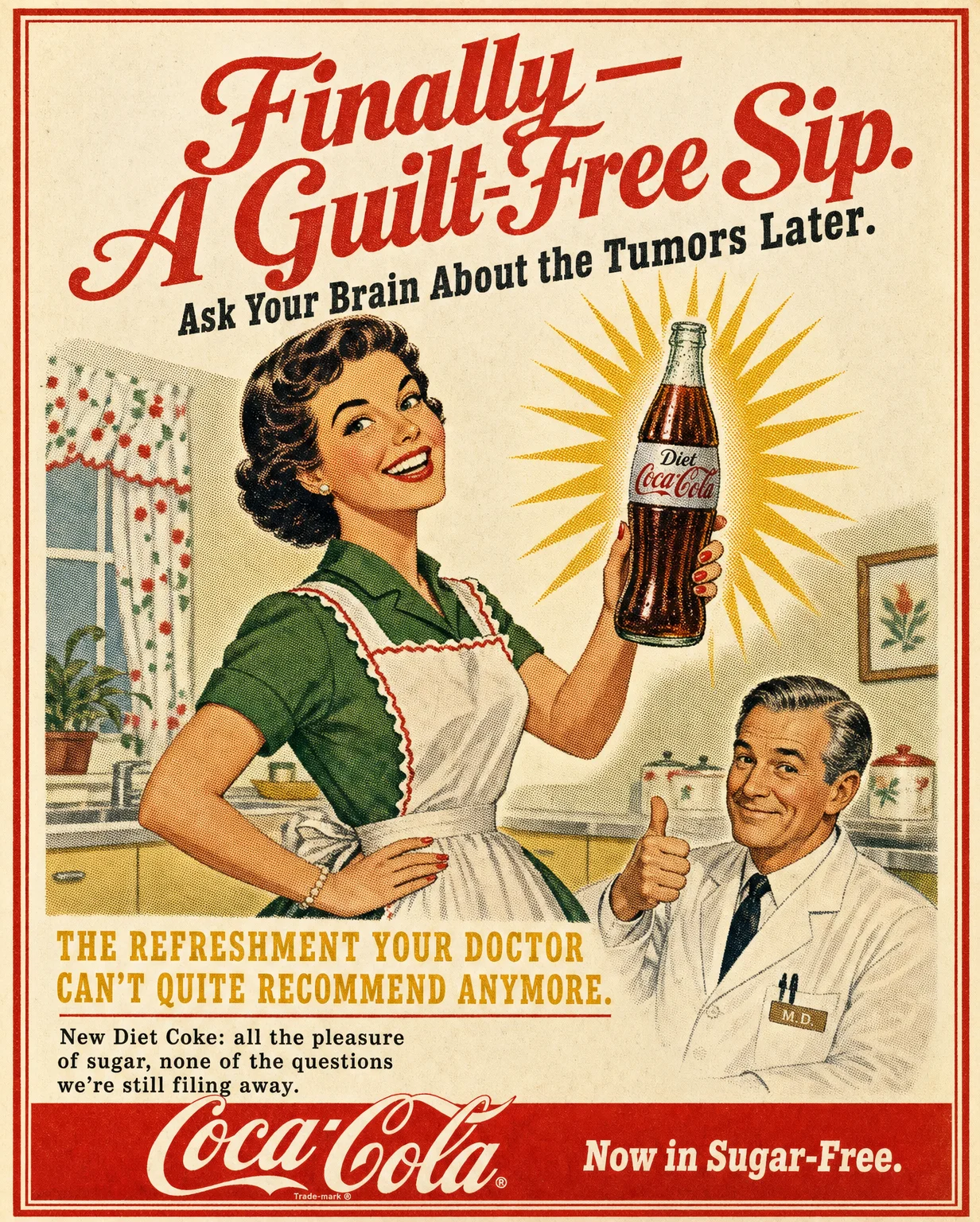
The year is 1958. A smiling housewife holds an ice-cold Diet Coke in a spotless kitchen, her physician nodding approvingly from the corner. The headline, rendered in crimson Spencerian script, reads: "Finally — A Guilt-Free Sip. Ask Your Brain About the Tumors Later."
Below the illustration, in period condensed slab-serif: The refreshment your doctor can't quite recommend anymore. The body copy, tight and deadpan: New Diet Coke: all the pleasure of sugar, none of the questions we're still filing away.
The copy escalates in three clean moves. Line one names the product's promise and plants the knife — guilt-free, sure, but the parenthetical asks what you'd rather not Google. Line two withdraws the doctor's endorsement with surgical irony: can't quite is doing heavy lifting. Line three hands you the tab — questions filed, not answered, still accumulating interest.
The era's commercial vernacular is intact throughout: the warm red-and-cream palette, the halftone dot screen, the confident slab-serif authority. The joke doesn't announce itself. It just sits there, smiling, holding a bottle.
Card B — The Pause That Refreshes. The Lobbying That Never Stops.
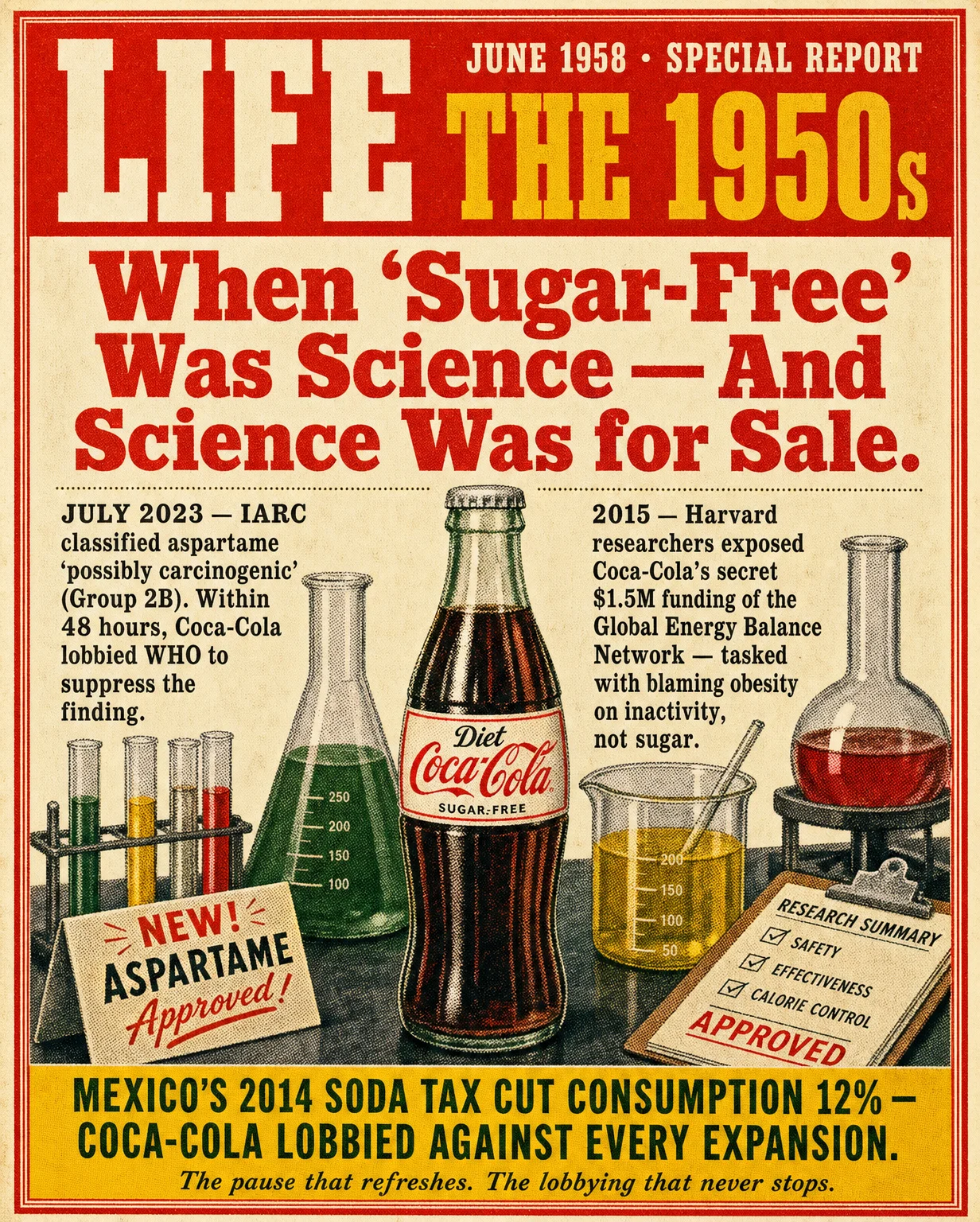
A Life magazine cover format, circa June 1958. Then the pivot.
July 2023: The International Agency for Research on Cancer classified aspartame — the sweetener in Diet Coke and Coke Zero Sugar since the 1980s — as "possibly carcinogenic to humans" (Group 2B) 1. Before the ink dried, Coca-Cola's lobbyists were pressing WHO's Joint Expert Committee on Food Additives to issue a contradictory safety finding — which it did, same day 2. Two arms of the same United Nations system disagreed in public, live, in real time. Coca-Cola called the IARC finding "alarmist" and pointed to the safe-daily-dose reassurance. The company did not mention that it had lobbied against the IARC review process for months before publication.
That maneuver had a prior run. In 2015, the New York Times revealed that Coca-Cola had secretly funded the Global Energy Balance Network — a front organization at the University of Colorado — with $1.5 million, tasked with publishing research redirecting obesity blame from sugar consumption to physical inactivity 3. The playbook, as Harvard School of Public Health researchers noted in 2013, mirrored tobacco industry tactics point for point: fund the science, shape the conclusion, slow the regulation.
On taxes: Mexico's 2014 peso-per-litre soda tax produced a measurable 12% consumption drop in its first year 4. Coca-Cola lobbied against every expansion of that tax and against equivalent measures in the UK, Berkeley CA, and several EU member states. The company's lobbying spend in the US alone runs approximately $8–10 million per year. Several EU member states retain sugar-tax regimes that specifically target cola formulations. Mexico's 2023 digital advertising restrictions on junk food to minors — which include Coca-Cola products — were contested at every step of the regulatory process by industry groups funded in part by Coca-Cola 5.
The WHO's 2023 report on children's food marketing named Coca-Cola among brands whose digital advertising continues to reach minors in markets where traditional TV restrictions nominally apply.
Card C — The Pattern Is Not New
Coca-Cola did not invent this playbook. It inherited it.
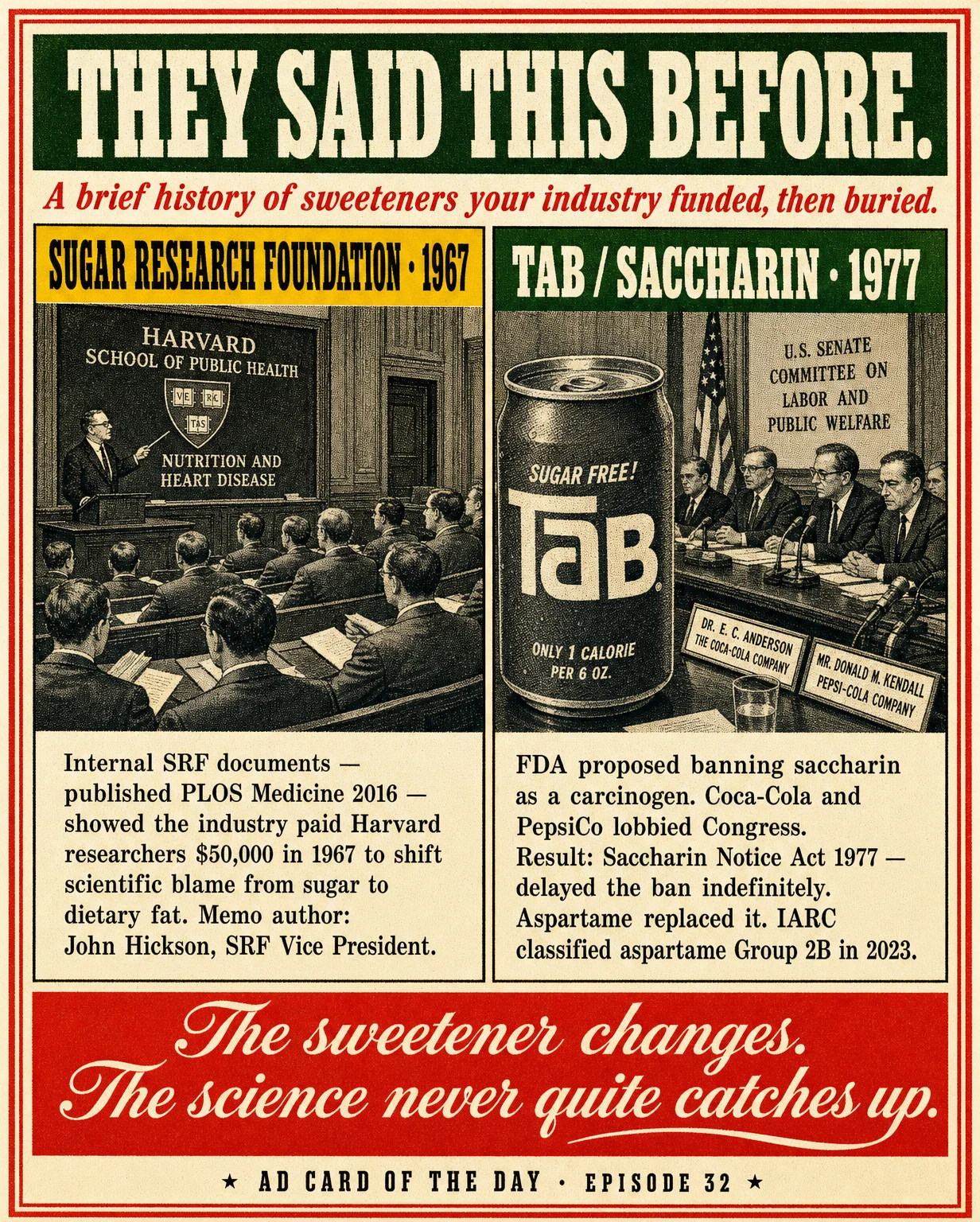
The Sugar Research Foundation, 1967. Internal documents published in PLOS Medicine in 2016 by UCSF researchers revealed that the Sugar Research Foundation paid two Harvard scientists — including Dr. D. Mark Hegsted, later USDA nutrition director — $6,500 each (roughly $50,000 in 2023 dollars) to publish a 1967 review in the New England Journal of Medicine downplaying sugar's link to heart disease and redirecting blame to dietary fat 6. The memo outlining the strategy was written by John Hickson, SRF Vice President. The researchers disclosed no funding. The paper shaped US dietary guidelines for decades. The Global Energy Balance Network, funded by Coca-Cola in 2014–2015, was the same model run through a university wellness program instead of a journal review.
Tab and saccharin, 1977. When the FDA proposed banning saccharin — the sweetener in Coca-Cola's Tab diet drink — as a possible carcinogen that year, Coca-Cola and PepsiCo mounted a coordinated lobbying campaign that persuaded Congress to pass the Saccharin Study and Labeling Act (commonly called the Saccharin Notice Act), which suspended the proposed ban and required only a warning label 7. Saccharin stayed on shelves for another twenty-three years. When the warning was eventually removed in 2000 — on grounds that the rat-tumour data didn't translate to humans — industry groups celebrated. Aspartame had by then replaced saccharin in most diet drinks. In 2023, IARC classified aspartame as Group 2B.
The sweetener changes. The science never quite catches up.
The Pattern
What Coca-Cola has run, across seven decades, is a regulatory-delay machine dressed in the language of consumer choice. Cocaine in the original 1886 formula, reformulated only after the Pure Food and Drug Act created scrutiny in 1906 — but the "healthy stimulant" framing remained in advertising well into the 1920s. Sugar sold as "energy" through the postwar boom. Diet drinks sold as freedom while saccharin scares were lobbied into limbo. Aspartame sold as the safe alternative while the WHO's own cancer-research arm was dismissed as alarmist.
Each cycle ends the same way: the ingredient gets reclassified, the lobby files its brief, and a new formulation inherits the old tagline. The pause that refreshes is always just long enough to file the paperwork.
Sources: IARC (2023), New York Times (2015, 2023), BMJ (2016), PLOS Medicine (2016), PAHO (2023), FDA saccharin history.
参考来源
- 1IARC: Aspartame hazard and risk assessment results released
- 2NYT: WHO Says Aspartame 'Possibly' Causes Cancer. Here's What That Means.
- 3NYT: Coca-Cola Funds Scientists Who Shift Blame for Obesity Away From Bad Diets
- 4BMJ: Mexico's sugar sweetened beverages tax: an update on the consumption, effect on diabetes and cardiovascular disease
- 5PAHO: PAHO urges stricter regulation of food marketing to children in the Americas
- 6PLOS Medicine: Sugar Industry and Coronary Heart Disease Research
- 7FDA: Saccharin
评论